


Denny's Driveshafts Frequently Asked Questions
Here is a small collection of frequently asked questions about driveshafts and driveline related items. Look over the list and hopefully it will help you with your problem. Unfortunately we cannot address every question here on this page and there may still be some unanswered questions that you may have. If you have something that is not answered her please see our Contact Us Page and fill our the form with your info. We will answer as soon as possible.
Frequently Asked Questions
Angle
How much driveline angle is right for my application?
Balance
Is driveshaft balance really necessary?
Casting Numbers
Why is the number on my part different than the part number on the box?
Diesel Pick Up Trucks
What is available for my Diesel pick up truck?
Exhaust System Clearance
FAQ
I don't know which driveshaft to choose...can you help?
How much slip travel should I have?
Why does the rear u-joint fit loosly in the pinion yoke?
How tight should I tighten my u-bolts?
Why does my rear u-joint wear out so often?
Can I order a driveshaft without a transmission slip yoke?
Can I order a driveshaft without u-joints?
Why did my driveshaft tubing twist or break?
My driveshaft is too short. Can I put on a longer slip yoke to make it fit better?
My driveshaft is too short. Can you add a little tubing to it to make it longer?
How tight should I tighten the grease fitting on a universal joint?
Import Driveshafts & Driveline Parts
Do you offer driveshafts or driveline parts for Import cars and trucks?
Maintenance
How often should I add grease to my non greaseable u-joints?
How often should I grease my greaseable u-joints?
Measuring Questions
Do I have to measure to order a driveshaft?
Can I send in my driveshaft so you can use it for a template?
How much of a mistake am I allowed in my measurements?
I want to order a driveshaft but my car is all apart?
Mispronounced Words
Is it called a Double Cardigan or is it a Double Cardan?
Is it called a Spleen or a Spline?
Is it Dana Splicer or Dana Spicer?
How do you say the company name "NEAPCO"?
Payment
What forms of payment do you accept?
RETURNS
How do I go about returning a part?
Series
What is the difference between 1310, 1330 and 1350 Series?
When is it necessary to upgrade to 1350 series?
What is the difference between the Chrysler 7260 and 7290 series?
What is General Motors 3R Series?
Spline Count
My slip yoke has a space where it appears that one spline is missing.
Troubleshooting
Why do I continue to break u-joints?
My transmission slip yoke feels like it is binding inside my transmission?
Urethane or solid mounts
Answers to Frequently Asked Questions
Angle
How much driveline angle is right for my application?
Thats a loaded question. The best answer is....the least amount of driveline or u-joint angle is the best amount of angle. Try to achieve the least amount of u-joint angle but don't make it less than 1 degree. A little known fact about u-joints is that they require about 1 degree of operating angle to get the needle bearings rotating. If they do not rotate they will fail. Too much angle will also cause them to fail. The type of rear suspension also plays a big part in setting the angles as well as the engine/transmission angle. Leaf spring cars have a need for more downward pinion angle due to spring wrap-up while coil spring cars control the situation better. Hard acceleration as in the case of a drag race car requires a different setting than a street driven car. Traction bars, ladder bars, 4 links, independent rears all have special needs and requirements.
Balance
Is driveshaft balance really necessary?
YES! Driveshaft balance is necessary for smooth driveline operation and to eliminate the destructive effects that an unbalanced or poorly balanced driveshaft will have on your transmission and rear end. At Denny's Driveshafts we High Speed High RPM Balance every driveshaft to meet or exceed the top rpm requirements of your engine and transmission, especially in the case of an overdrive transmission where the driveshaft rpm is greater than the engine rpm in high gear. This is very important and should not be overlooked when purchasing a new driveshaft. We can balance and test to 10,000 rpm so whatever your requirements are we can meet them. This will ensure that you will have the smoothest ride at all road speeds and track speeds and also a quicker ET. You won't be limited by rear end gear ratio and you will experience smooth running especially when using an overdrive transmission. True high speed balance means balancing at a High RPM.
Casting Numbers
Why is the number on my part different than the part number on the box?
What you are seeing is the casting or forging number for the base part. These numbers are typically found on slip yokes, weld yokes, flange yokes, double cardan stud yokes and "h" yokes and many more parts. Most often if the part is a "casting" it will have a number that starts with a "C" and if it is a forging then it will start with an "F". This most often is never the actual part number because the factory may make many different part numbers from one base casting or forging. It is a smart way for the manufacturers to cut costs on similar parts. So when you see the number on the yoke does not match the number on the box...don't panic. It's not supposed to match!
Diesel Pick Up Trucks
What is available for my Diesel pick up truck?
At this time we do not offer driveshafts in the 1480 series for diesel pick up trucks. We do, however, offer 1480 and1485 Spicer universal joints to replace your originals. Some diesel pick up trucks whether 2wd or 4wd require 1480 series to handle the horsepower and torque output of todays high performance diesels. We will offer custom built 1480 series driveshafts in the future but at this time we do not.
Exhaust System Clearance
I recently had a 3 inch exhaust system installed on my car and now I do not have much clearance for the driveshaft. What is the smallest diameter driveshaft that I can use that will handle the horsepower and weight of my vehicle?
This is a common and growing problem that we hear about more often than we ever did before. You should always have the driveshaft built before the exhaust system to avoid all of these problems. The high horsepower cars and trucks that need a 3 inch exhaust system also need a strong driveshaft. Unfortunately the tunnel does not always allow for the proper size driveshaft and the 3 inch pipes to all fit into the same space. Some high horsepower cars can use a 3 inch diameter driveshaft with no problems but others may require a 3.5 inch or a 4 inch and now it won't fit with the large diameter pipes. Length is a big factor in the proper selection of driveshaft tube diameter. The long wheelbase cars cannot use a 3 inch driveshaft due to length, rpm and critical speed issues but a short wheelbase car can use a 3 inch or a 3.5 inch if the space allows. Driveshaft critical speed is not a problem with shorter overall lengths. The advice here is to be sure that your exhaust system installer makes room for the 3.5 inch diameter as a minimal choice for a driveshaft tube diameter. Some of you with long wheelbase vehicles may in fact need a 4 inch driveshaft... so be sure to let the installer know what you may need before he begins the work. Better yet...get the new driveshaft first!
FAQ
I don't know which driveshaft to choose...can you help?
Yes we will be happy to help you make the right driveshaft choice but first we will need to know the dimensions of your application and also more information about the vehicle. Please select the appropriate measuring diagram for your vehicle and print it out so that you can have it with you under the vehicle as you do the measuring. After you have measured please email or call with those dimensions so that we can accurately recommend which driveshaft will be best for your vehicle. Click here to find the right diagram.
How much slip travel should I have?
In most applications the minimum is 3/4 inch and more than 1 inch is not necessary. This is measured with the rear suspension supported on safety stands or with the rear end on the ground.
EBAY PURCHASES....How much will I save if I buy a new slip yoke on ebay and send it to you to install onto my new driveshaft?
You may not save anything and in fact it may cost you more to do it that way. All Denny's Driveshafts are priced as a complete package. The cost of the slip yoke is factored in at an amount that is less than what you would pay to buy it separately. If you bid for the slip yoke on an ebay auction or if you select it as a "buy it now", your cost plus shipping it to you and then shipping it to us is almost always going to be more than it would have been if we had supplied the whole driveshaft including the slip yoke. The only way that it may save you money is if you purchased an expensive chrome moly slip yoke and paid less than half of what it normally sold for. Please call for the adjusted cost if you have a slip yoke you want us to use on your order.
Why does the rear u-joint fit loosly in the pinion yoke?
A common mistake that is made when measuring is to measure the rear u-joint caps instead of measuring the pinion yoke. This is most common on Ford rear ends where a 1 1/8 inch cap diameter is found at the yoke saddles. Unfortunately someone has installed a u-joint with 1 1/16 inch caps. Always measure the pinion yoke.
How tight should I tighten my u-bolts?
1310 series and 1330 series should be tightened to 17 ft/lbs and 1350 series to 20 ft/lbs. You should never tighten the nuts on any u-bolt excessively. This will cause the cap to distort and the u-joint will fail prematurely.
Why does my rear u-joint wear out so often?
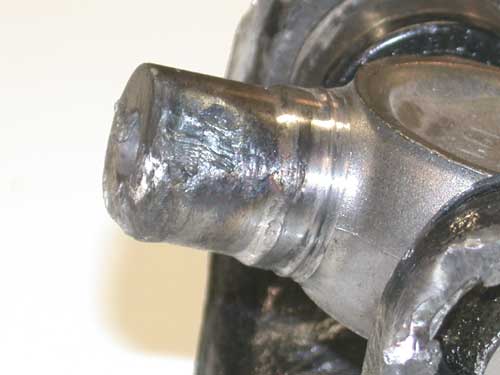
This is usually the case when a u-bolt style pinion yoke is used. The pinion yoke is not the problem the overtightening of the u-bolt is the cause of the failure. You may find that every time you change the damaged rear u-joint you will find that one or both of the journals or caps that are under the u-bolts are destroyed and the ones that are pressed into the shaft are still in good shape. You did it to yourself! 17 ft/lbs for 1310 & 1330 series and 20 ft/lbs on the 1350 series. Click to see Photo
Can I order a driveshaft without a transmission slip yoke?
Yes. We will need your slip yoke to balance your driveshaft correctly.
Can I order a driveshaft without u-joints?
No. We cannot build and balance a driveshaft correctly without u-joints.
Why did my driveshaft tubing twist or break?
There are many reasons. If you are using a stock driveshaft in a racing application then you already know the answer. Stock shafts should never be used for racing. If you had a driveshaft built by a driveline shop and it has broken or twisted the tubing then you should take it back to where you bought it. They apparently built your driveshaft with tubing that was similar to stock driveline tubing or possibly selected a tube diameter or thickness that was not correct for your application. Just because the shop builds dump truck shafts does not mean it can handle the requirements of a race car.
My driveshaft is too short. Can I put on a longer slip yoke to make it fit better?
This is a common problem and many times this seems like an inexpensive way to make it fit better but this type of fix should be avoided. We never recommend installing a longer slip yoke when the shaft is actually too short for the application. Some transmission slip yokes are available with a longer barrel but they were designed longer for a specific application and not for the purpose of extending a shaft. Using one on a driveshaft that is actually too short for the application can lead to vibration and output shaft bushing failure. In extreme cases the internal spline can twist and bind up the slip movement. Don't do it!
My driveshaft is too short. Can you add a little tubing to it to make it longer?
No. The correct way to lengthen a driveshaft is to remove both weld yokes and install a new tube of the proper length.
How tight should I tighten the grease fitting on a universal joint?
Seems like a dumb question but actually it is a very good question. This is a question that should be asked more often but is almost never asked until someone breaks the grease fitting off in the u-joint. You don't need to tighten the fitting as if you were tightening lug nuts!!!! These things can break and they will break if tightened too much. The question now is how much?? We use a simple nut driver (looks like a screw driver with a socket on the end) to install and tighten grease fittings. No ratchets, no breaker bars, no impact guns. You DO NOT NEED much more than a snug fit and that fitting will stay put for a million miles. The threads on the fitting are tapered like a pipe thread so it is going to put up some resistance as you screw it in. There is absolutely NO GOOD REASON to bury that fitting into the u-joint by tightening it until the hex on the fitting comes in contact with the u-joint body. Don't do it because it will break!!! Remember a hand tight snug fit and you're done. There will be some threads exposed and that is perfectly acceptable. Enough said!
Import Driveshafts & Driveline Parts
Do you offer driveshafts or driveline parts for Import cars and trucks?
At this time we do not offer driveshafts or driveline parts for Imports. We may, however, offer them at a later date. When we do it will be posted on our home page.
Maintenance
How often should I add grease to my non greaseable u-joints?
Never! Just leave them alone and they will last for a very long time. You can do more harm than good by taking them apart.
How often should I grease my greaseable u-joints?
Greaseable u-joints should be greased every 3000 miles or possibly more often. You cannot over grease a greaseable u-joint.
Measuring Questions
Do I have to measure to order a driveshaft?
YES! We want your order to fit correctly. Measuring is the only way we can be sure your driveshaft will fit and perform perfectly for you. We have provided the best measuring diagrams in the business so that you can easily get the right dimensions
Can I send in my driveshaft so you can use it for a template?
Yes you can. As long as you are 100 percent sure it fits correctly. Please let us know if you want it returned.
How much of a mistake am I allowed in my measurements?
NONE!!! Its too easy to get it right so why do it wrong. Never use the hook on the end of a tape measure to measure a u-joint. It is best done with a good steel machinists ruler or a dial caliper but if those tools are not available any good ruler will do as long as it reads down to 1/16 of an inch. Use the tape measure hook for the overall length only!
I want to order a driveshaft but my car is all apart?
Unfortunately it will be best for you to wait until you have it back together to measure correctly.
Mispronounced Words
Is it called a Double Cardigan or is it a Double Cardan?
The correct pronunciation for the two u-joint CV knuckle on a driveshaft is "Double CARDAN" pronounced (car-dan). It is commonly mispronounced Double Cardigan. A Cardigan is a piece of clothing.....it is a sweater.
Is it called a Spleen or a Spline?
The correct pronunciation is Spline...with a "long" I. The spleen, with a "long" E is an organ in your body.
Is it Dana Splicer or Dana Spicer?
The correct pronunciation is Dana SPICER. Think of the word SPICE with an "R" on the end.
How do you say the company name "NEAPCO"?
The correct pronunciation of the company name NEAPCO is "KNEE - APP - CO".
Payment
What forms of payment do you accept?
We accept MasterCard, Visa and Discover credit cards.
RETURNS
How do I go about returning a part?
To return a part please click on this link to read our Return Policy and to PRINT out the RETURN FORM. A properly filled out RETURN FORM is required to be in the box with the returned part(s) to get a refund.
CLICK HERE for RETURNS
Series
What is the difference between 1310, 1330 and 1350 Series?
The "series" of a driveshaft or universal joint is determined by the actual dimensions of the u-joint. While the front and rear u-joint can be of two different sizes the shaft is only as strong as the smaller one. The 1310 series u-joint measures approximately 3 1/4 inches wide. The 1330 and 1350 both measure approximately 3 5/8 wide. The 1310 and 1330 series can have cap diameters of 1 1/16 and/or 1 1/8 inch or a combination of both sizes. The 1350 series has a cap diameter of 1 3/16 inch and the body and journals are bigger than the 1310 or 1330. Remember 1350 is almost never found in production car driveshafts.
When is it necessary to upgrade to 1350 series?
It is always a good choice to upgrade to the 1350 series components whenever your application is used for racing or with high horsepower and street use. Stock driveshafts were designed to handle a modest amount of horsepower. If your application has more than 400 horsepower then its time to consider a new shaft.
What is the difference between the Chrysler 7260 and 7290 series?
The 7260 and 7290 series are the two sizes that are commonly found on Chrysler products. They represent the two stock sizes that have been used for many years. The 7260 series is the “small” Chrysler u-joint size (2 1/8 inch between flats on yoke with 1.078 inch bearing cap diameter) and the 7290 series is the “big” Chrysler u-joint size (2 5/8 inch between flats on yoke with 1.125 inch bearing cap diameter). The 7260 series is similar in size to the 1310 series and the 7290 is similar in size to the 1330 series. They both utilize the inside “C” clip design to hold the u-joint within the yoke flats whereas the 1310 and 1330 use the outside snap ring design.
What is General Motors 3R Series?
General Motors typical u-joint size found on most passenger cars and light trucks is commonly know by a few names. They may be referred to as “3R” or “Saginaw” but they are all one in the same. Depending on who is doing the talking you may hear any one of these terms. The 3R series measures 2 9/16 inches between flats on yoke with a 1.125 bearing cap diameter. The factory original u-joints are held into the yokes by injected plastic. This u-joint is similar in size to the 1330 series. The replacement u-joints utilize the inside “C” clip design to hold the u-joint between flats within the yoke whereas the 1330 series uses the outside snap ring design. You should be extremely careful not to heat the plastic with a torch to remove the original u-joints because the heated plastic will emit toxic fumes that are not good for your health.
Spline Count
My slip yoke has a space where it appears that one spline is missing.
Yes you may find that your slip yoke has the space where one spline is missing. When counting splines you always count the actual spline tooth and you will always add one more to your total count when you see the space. For example on a GM TH-350 slip yoke you may see 26 internal splines and a space...this is in fact a 27 spline slip yoke. This applies to ALL splined parts that have the space. For Chrysler owners you may see some companies list their 904 slip yoke as a 25 spline or 25/26 when in fact it has a 26 spline output shaft on the transmission. The 727 slip yoke may be listed as a 29 spline or 29/30 when in fact it is has a 30 spline output shaft on the transmission. This can be very confusing when selecting a slip yoke. The space is found on the slip yoke but is not found on the output shaft of the transmission or transfer case. There is no need to try to match the space with a corresponding spline on the output shaft. You can install the slip yoke in any position on any spline and it will perform the same way each and every time. The transmission output shaft is always the best choice when counting splines because they always have the full amount. Remember this and you will never be confused again.
Troubleshooting
Why do I continue to break u-joints?
The answer can be that the u-joint series is too small for the application. Or possibly you are using an inexpensive parts store u-joint that does not offer strength. Maybe you are using a greaseable u-joint and it is breaking across the grease fitting hole. The corresponding yoke is damaged or distorted and causing premature failure.
My transmission slip yoke feels like it is binding inside my transmission?
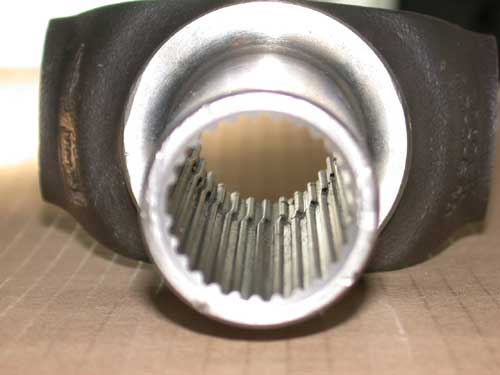
The problem may be that the internal splines of the slip yoke barrel have a slight twist and the slip yoke needs to be replaced. This problem may be the result of too much horsepower for the slip yoke design and or material. A manual transmission or an automatic with a trans brake can cause this damage because of the forces applied to the splines during a starting line launch. If you look inside the slip yoke you will see a slight twist to the spline. This twist is usually at a point that corresponds with the end of the transmission output shaft. As you insert the slip yoke into the transmission it will bind when it reaches the twisted area. Click to see photo.
Urethane or solid mounts
Does having urethane or solid mounts cause more driveline noise to be felt and heard while driving or racing?
YES! Having urethane or solid mounts of any kind at any location on the vehicle will transmit noise, Urethane or solid mounts can be benificial to tighten up a suspension for better performance but the down side is the noise when driven on the street.... especially in an otherwise quiet vehicle. Urethane or solid engine mounts, transmission mounts, body mounts or control arm bushings will transmit more mechanical noise and road noise throughout the chassis and interior of the vehicle. You will hear and feel these noises much more than if you had rubber mounts. Nothing dampens noises better than rubber. Depending on where the noise is coming from it can be described as a buzzing sound or a droning sound with a rythmic oscillation. You will hear every moving part in your entire vehicle including road noise. Some people are ok with this and some people will go crazy because it is not always pleasant. For racing it's ideal...for street it's annoying. If you ever had a vehicle that had an exhaust pipe or clamp come in contact with the floor or frame then you know how much noise can be transmitted. Now think of this mulitiplied by many times. Typically the driveshaft is usually not the cause, unless it is out of balance, but even a perfectly balanced driveshaft can act as the "speaker" which can amplify and transmit the mechanical noise or road noise.